

NSK-BAdvantages
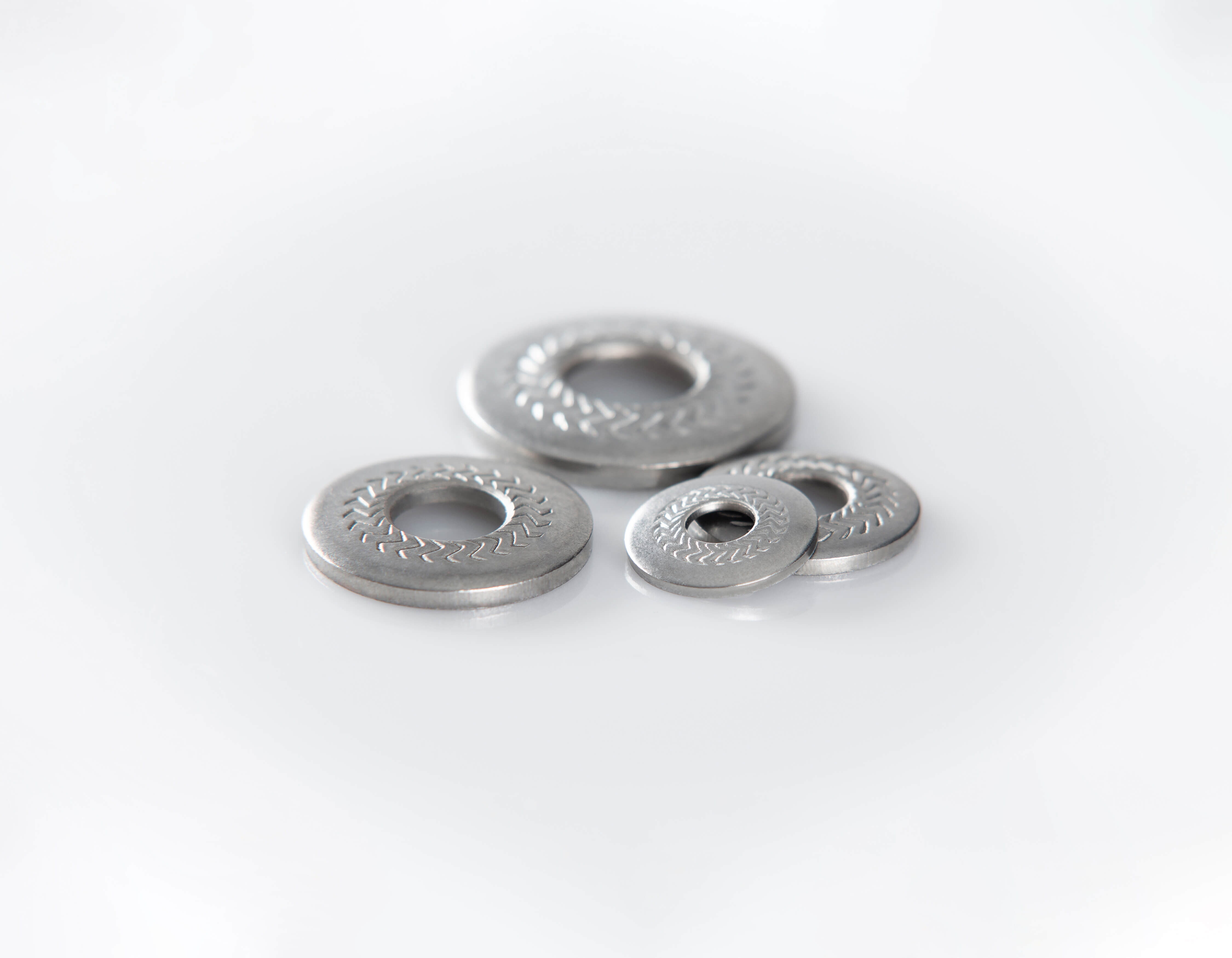
NSK – Multifunctional Safety for Mechanical Screw Connections
1. Lifecycle-Oriented Preload Stability
- Stabilization of the preload force throughout all phases of the bolted joint
(Assembly → Embedding → Relaxation → Operation) - Reduction of set, creeping, and relaxation losses
- Prevention of critical preload force drops
- Ensuring the required clamping force throughout the service life
- Expansion of the safety approach from purely preventing loosening to systemic preload stability
2. Multifunctional system safety without conflicting objectives
- Multifunctionality as the central operating principle: Combination of anti-loosening and anti-rotation protection in a single system
- Simultaneous force-locking, form-locking, and friction-locking effects
- Resolving the conflict of objectives in conventional locking systems
- Integration of multiple mechanisms of action instead of focusing on individual principles
3. Increased slip resistance and operational safety
- Increase in usable frictional locking reserve
- Increased protection against slip and opening
- Improved force distribution within the connection
- Stabilization of overall mechanical function
- Support for system function, not merely securing against relative rotational movement
4. System flexibility and load distribution
- Increased resilience of the screw system
- Improved load distribution between the screw and clamping parts
- Optimized pressure distribution through radial geometry with two contact points
- Reduction of screw load
- Protective effect during short-term overloading through elastic energy absorption
- Active system support instead of purely passive securing effect
5. Calculability and standard-compliant design (VDI 2230)
- Defined resilience and residual spring force in accordance with DIN 267-26
- Incorporation into the design according to VDI 2230
- Reproducible friction coefficients for reliable assembly processes
- Technically controllable and designable system behavior
- Integration into the structural system design rather than purely additive securing elements
6. Functional safety under real operating conditions
- Proven resistance to loosening under dynamic transverse loads
(DIN 65151, DIN 25201-4) - Effectiveness during embedding, creeping, and relaxation processes
- Resistance to vibrations and alternating loads
- Stabilization even at reduced preload levels
- Comprehensive effectiveness across real operating conditions
7. Assembly and Process Reliability
- One-piece system → no loss of parts / no mix-ups
- Simple and secure assembly
- Reduction of assembly errors
- High process reliability in production and maintenance
- System integration reduces interfaces and sources of error
8. Cost-Effectiveness and System Integration
- Reduction in Total Cost of Ownership
- Reduction in maintenance and repair costs
- Minimization of downtime risks
- Potential for weight and component optimization
- Multifunctionality reduces the number of components and system complexity
Summary
NSK stands for multifunctionality in screw locking.
- Expanding beyond traditional anti-loosening protection to achieve systematic preload stability
- Integration of multiple mechanisms of action into a single fastener
- Increased functional reliability over the entire life cycle
- Technically calculable, standards-compliant, and cost-effective
NSK doesn’t just secure screws—NSK secures the function of the connection
Relaxation
Embedding
Creeping
Loosening
Slip resistance
DIN 267-26
DIN 25201