

NSK-NAdvantages
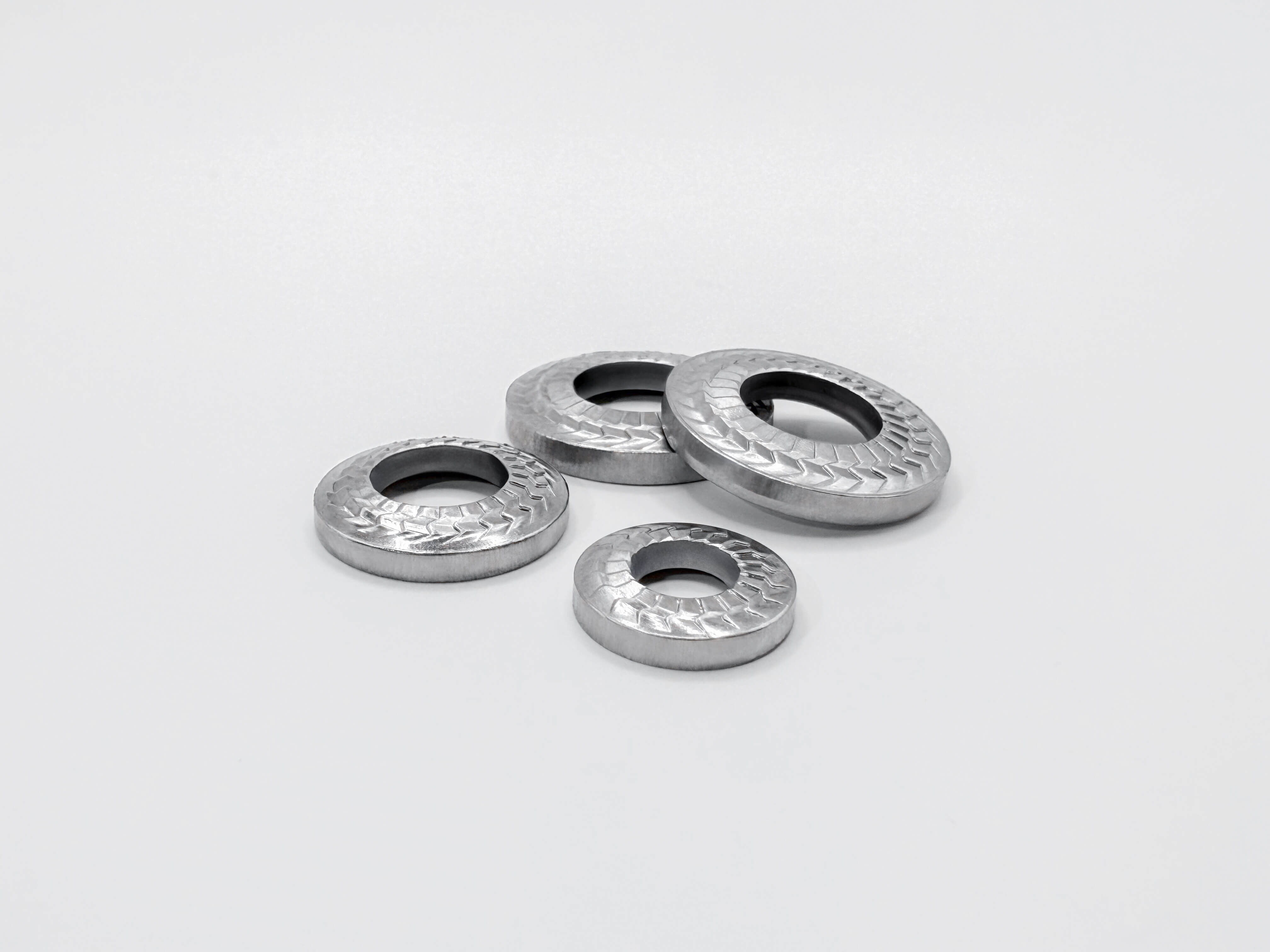
NSK-N: Securing Stainless Steel Screw Connections
1. Sustained preload as the foundation for maintenance-free fasteners
The key challenge with bolted joints is not loosening, but the loss of preload.
Embedding, creeping, and relaxation processes—particularly in stainless steel joints—lead to a continuous reduction in preload. The consequences are the need for retightening, increased maintenance costs, and reduced operational reliability.
NSK-N stabilizes the preload force throughout the entire life cycle of the joint, thereby significantly reducing maintenance and downtime.
2. Multifunctional and Customizable System Solution
Unlike traditional securing elements, NSK-N fulfills several functions simultaneously:
- Stabilization of the preload
- Protection against self-acting loosening by rotation
- Increased resilience
Furthermore, this system effect can be taken into account for the first time in the bolt design calculations (VDI 2230, e.g., MDESIGN).
3. Reliable anti-loosening protection under real-world conditions
In addition to preload stability, NSK-N ensures reliable protection against loosening:
- Effective under vibration and transverse loads
- Verifiable in accordance with DIN 65151 and DIN 25201-4 (“Junker test method”)
- Protection even under dynamic load cycles
4. Superior corrosion resistance in real-world applications
Corrosion resistance is not only defined by the material but also verified on the component itself:
- 4,200-hour salt spray test per DIN EN ISO 9227
- Designed for CX/offshore-like environments per ISO 12944
- Resistant in chloride-containing, industrial, and outdoor applications
- Classification according to DIN EN 1993-1-4: RC III
5. Unique spring effect in A4 stainless steel
NSK-N generates a defined residual spring force despite the use of a corrosion-resistant A4 material.
- Defined residual spring force (DIN 267-26)
- Increased elastic resilience
- Compensation for settlement, creeping, and relaxation losses
6. Optimized design through calculable system resilience
For the first time, the defined elastic resilience of the NSK can be taken into account mathematically in bolt design (VDI 2230).
As a result, preload force stability is not only achieved but also specifically engineered. Designers are able to size screw connections more efficiently and make targeted use of system reserves.
Benefits for the user:
- reduced safety factors
- smaller screw and component dimensions
- weight and material savings
- lower system costs combined with higher functional reliability
Summary
NSK stands for multifunctionality in screw locking.
- Expanding beyond traditional anti-loosening protection to achieve systematic preload stability
- Integration of multiple mechanisms of action into a single fastener
- Increased functional reliability over the entire life cycle
- Technically calculable, standards-compliant, and cost-effective
NSK doesn’t just secure screws—NSK secures the function of the connection
Loosening
Relaxation
Embedding
Creeping
DIN 25201
DIN 267-26
Elastic Resilience